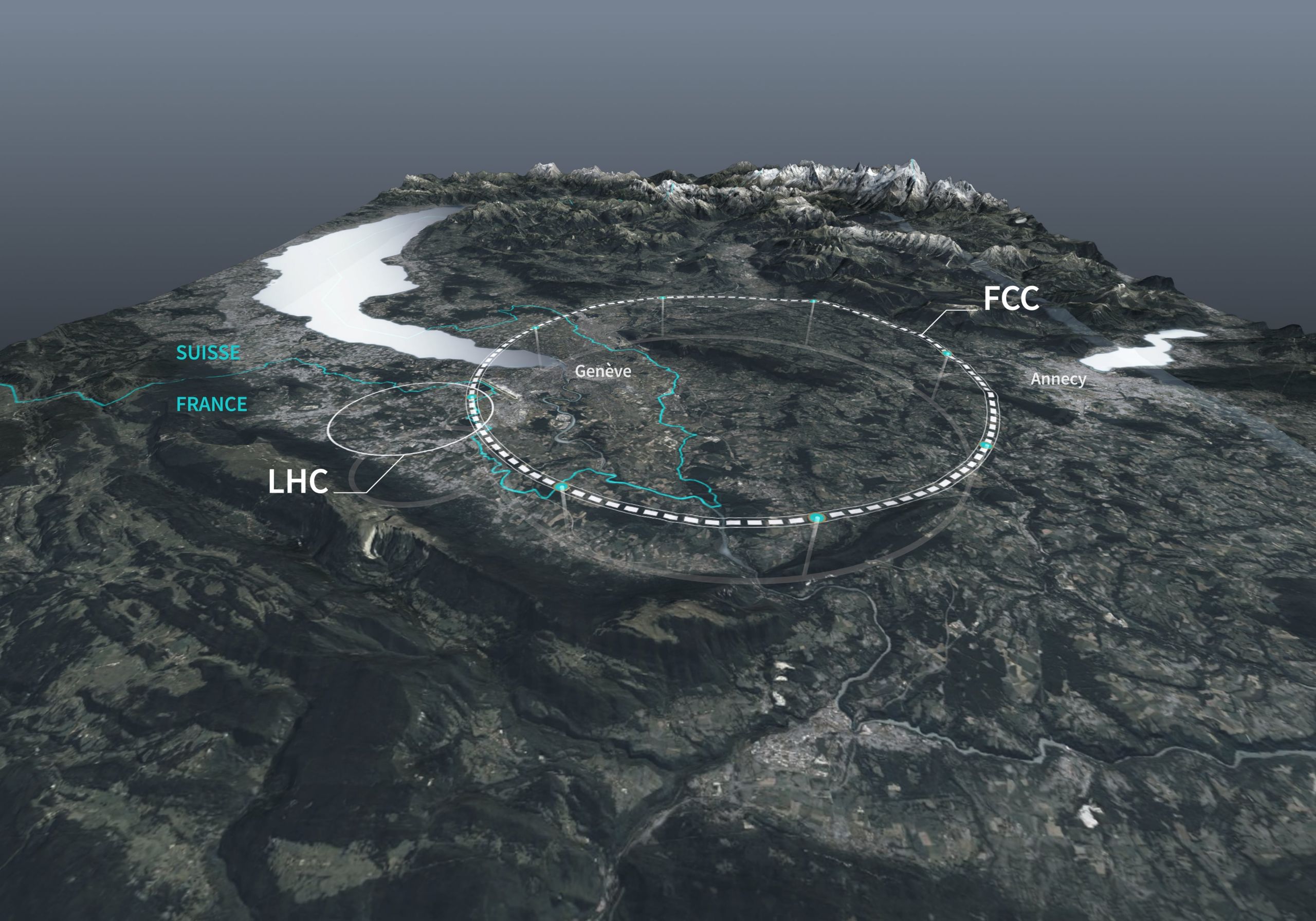
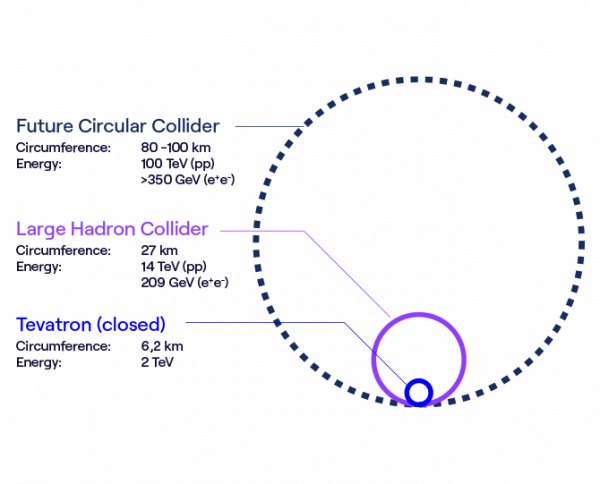
For the past 50 years, particle colliders have been among the primary scientific tools used to understand the universe’s most fundamental particles and laws. With its 27 km circumference, the Large Hadron Collider (LHC) is currently the world’s most powerful particle collider. The High Luminescence Stage (HL-LHC) will further enhance the machine’s discovery potential with a research program that will run until 2040. But CERN is already thinking beyond the LHC.
The future of high-energy physics in the 21st century depends on the design and construction of colliders that can push the energy and density limits far beyond current values. The Future Circular Collider (FCC) project explores different collider options combined into a single research infrastructure built in a 100 km underground tunnel, capable of delivering a robust and diverse physics program extending beyond the end of the century.
Context
One of the key recommendations of the 2020 update of the European Particle Physics Strategy is for Europe to conduct a feasibility study for a next-generation hadron collider in collaboration with the global particle physics community. Consequently, the Future Circular Collider (FCC) feasibility study from 2021 to 2027 investigates the technical and financial viability of such a facility at CERN.
The feasibility study includes a scientific component as well as numerous technical considerations, administrative and financial issues, and a comprehensive study of regional feasibility including geological, environmental impact, infrastructure and civil engineering.
If the outcome of the feasibility study is positive, CERN member states and international partners may approve a more comprehensive technical feasibility study of the project. This process may approve the next steps toward the final approval of the project and the start of construction after the mid-2030s; The first phase, the electron-positron collider (FCC-ee), is scheduled to become operational around 2045. A second machine, colliding protons in the same tunnel (FCC-hh), would extend the research program from the 2070s until the end of the century.
Feasibility Study for a New Research Infrastructure
The future collider will be built as follows:
~91 km
The FCC tunnel is a ring-shaped underground tunnel located beneath the Haute-Savoie and Ain regions of France and the canton of Geneva in Switzerland. Known constraints confine the layout to a limited area: the tunnel must avoid geologically complex areas; maximize the efficiency of future colliders; be connectable to the LHC; and the location of surface sites must respect social and environmental constraints. Therefore, various variants of the layout are being evaluated in accordance with the principles of avoidance, mitigation, and compensation, in order to ensure a sustainable design for future generations. The FCC tunnel was to house two colliders in succession. The first step, targeted to be operational in the mid-2040s, would be an electron-positron collider (FCC-ee) that would provide measurements of unprecedented precision and potentially lead to physics beyond the standard model. The second step would be a proton-proton collider (FCC-hh) that would reach energies up to eight times that of the LHC and offer new discovery potential.