
The proposed FCC integrated program envisions a new 91 km long circular tunnel in the Franco-Swiss region surrounding CERN, capable of hosting a new research infrastructure for particle physics.
The new tunnel will initially house an electron-positron collider (FCC-ee), enabling precise measurement of the properties of the Higgs boson and other Standard Model particles. The second step will be an energy-frontier proton collider (FCC-hh), offering collision energies of 100 TeV or higher (i.e., eight times the energy of the LHC) following advances in superconducting and magnetic technologies. In keeping with the tradition of previous Great Science projects, the FCC project will sustainably validate fundamental performance elements in particle accelerators while offering opportunities to develop advanced technologies for applications beyond high-energy physics in collaboration with industry. The FCC collaboration, supported by the EU-funded Horizon 2020 FCCIS project, has launched a Feasibility Study to support the development of a roadmap for the design and implementation of a new research infrastructure that will enable fruitful discoveries in both fields by the end of the 21st century.
Density limit lepton collider
The proposed circular lepton collider (FCC-ee) is a Higgs and electroweak factory energy-limit electron-positron collider with the highest radiation intensity, covering the energy range of 80 to 400 GeV. The clean environment of the circular lepton collider will allow for the high-precision study of Z, W, Higgs, and top particles, with trillions (5·10¹²) of Z bosons, 10⁸ W pairs, and millions (10⁶) of Higgs bosons and top quark pairs. The rich physics possibilities of FCC-ee include a combination of precise measurements, weakly coupled particle sensitivity, and rare process studies, which will shape and challenge particle physics for many years to come. Many experimental facts necessitate the expansion of the Standard Model; in particular: the supremacy of matter over antimatter in the universe; evidence of dark matter from astronomical and cosmological observations; And closer to particle physics, neutrino masses are approximately 10⁻⁷ times smaller than that of an electron. Possible solutions to these questions seem to require the existence of new particles or events that can arise over a very wide range of mass scales and interaction strengths. The discovery of new particles has in the past often been guided by predictions based on a long history of experimentation and theoretical maturation before their actual observation. In this context, a decisive improvement in the sensitivity of certain electroweak precision observations, combined with other precise measurements of the properties of hadrons including the Higgs boson, top quark, tau lepton, and charm and beauty quarks, can play a crucial role in integrating sensitivity to a wide range of new physics possibilities. The clean environment and high luminosity of FCC-ee will offer unprecedented sensitivity to signs of new physics, such as small deviations from the Standard Model, forbidden decay processes, or the production of new particles with very small interactions. Each fundamental ‘component’ of FCC-ee has already been proven in one or more colliders or test facilities. These proven components include, for example, the vertical spot size and transverse emittance of the beams, synchrotron radiation photon energies and synchrotron radiation power per unit length, beam charge, ‘crab waist’ collision scheme, radio frequency system, and positron generation rate. One of the greatest advantages of circular lepton colliders like FCC-ee is the possibility of serving multiple interaction points with a clear overall gain in both integrated luminosity and luminosity per unit of power consumption.
FCC-hh: Hadron Collider at the Energy Limit
FCC-hh focuses on a 100 TeV hadron collider with an integrated radiation intensity at least 5 times greater than that achieved during the lifetime of the LHC. This unprecedented center-of-mass collision energy will make FCC-hh a unique tool for exploring physics beyond the Standard Model, offering great direct precision for new physics and discoveries. By extending the current energy limit by almost an order of magnitude, FCC-hh will offer the potential for direct exploration of the multi-TeV region. This will allow the Higgs boson to explore the dynamics of electroweak symmetry breaking precisely and comprehensively at the TeV scale, and to elucidate the nature of the electroweak phase transition. Furthermore, the interaction between the FCC-ee and FCC-hh phases is essential for a wide range of unique Higgs measurements. FCC-hh will also provide a definitive answer about the WIMP paradigm, as thermal dark matter candidates will either be discovered or ruled out. Finally, building on the lessons learned from FCC-ee, this method could give us access to novel particles whose existence could only be indirectly predicted through precise measurements in the earlier FCC-ee phase.
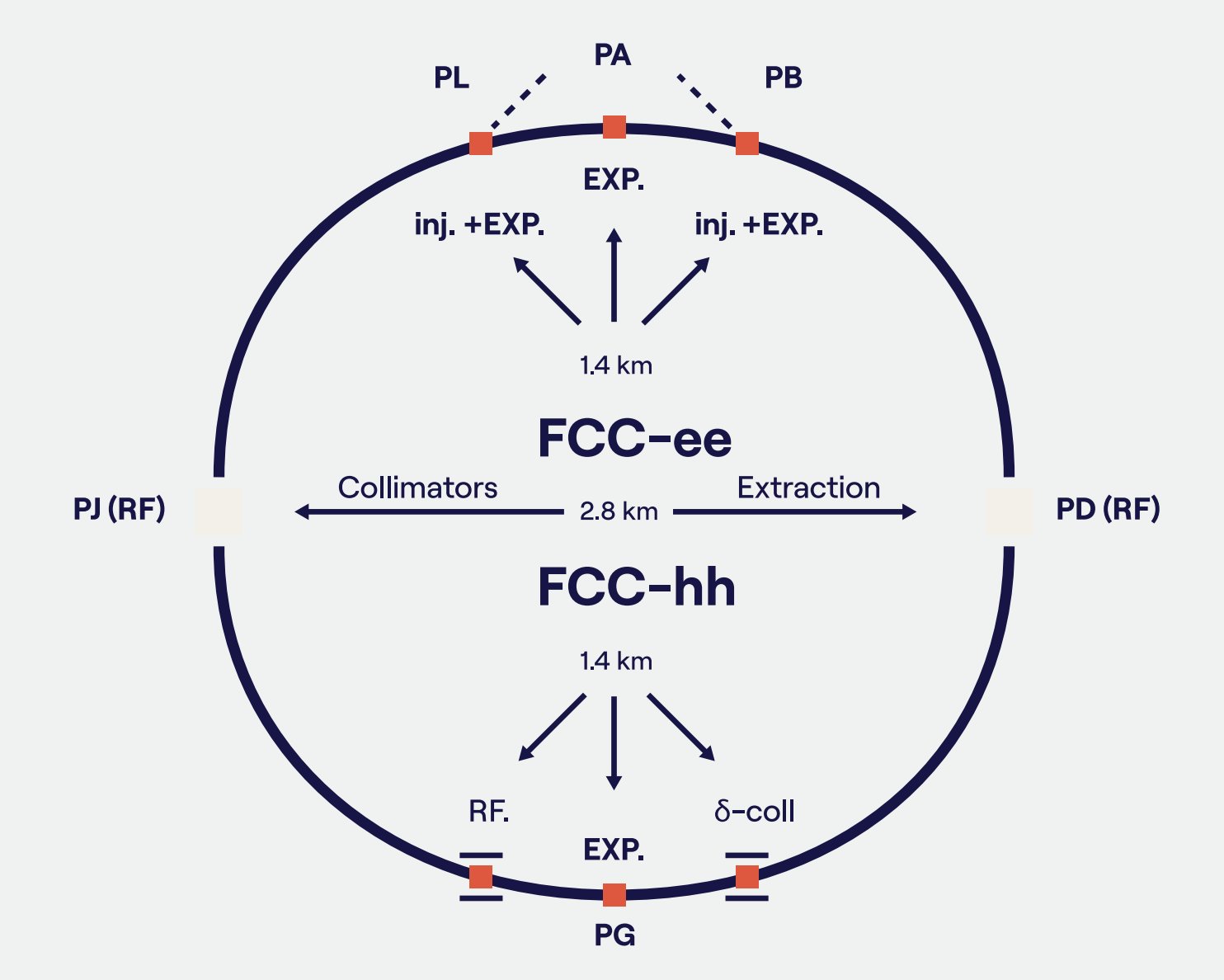
The FCC-hh layout has been developed to be consistent with the FCC-ee layout and to allow for seamless integration with CERN’s existing accelerator complex. Furthermore, it can host up to 4 experiments, as is currently the case at the LHC. This timeline makes it possible to bring the FCC-hh technologies to the necessary technology readiness level through a dedicated R&D program, improve their performance, and enable sustainable large-scale production. One of the key technologies for groundbreaking colliders in the energy field is high magnetic field magnets and their underlying superconductors. The ongoing High Luminescence Upgrade (HL-LHC) of the LHC is a significant milestone in this direction, including dozens of magnets with peak magnetic fields of 11-12 T. For FCC-hh, various configurations of 16 T and novel superconducting materials, along with high-temperature superconductor options, are currently being tested. Another important technology is an energy-efficient cryogenic cooling infrastructure and a high-reliability distribution system based on novel coolants. Finally, optimization of high-power beam transfer and local magnet energy recovery are among the technologies that will improve performance and find applications beyond particle physics.
As a single project, FCC-hh will serve the global physics community for approximately 25 years. When combined with a lepton collider (FCC-ee) as the first step in the same tunnel, it will provide a global, multi-decade research program that will last until the end of the 21st century.
FCC Integrated Programme
The most effective and comprehensive approach to thoroughly investigating the open questions in modern particle physics is a phased research program integrating lepton (FCC-ee) and hadron (FCC-hh) collision programs, respectively, to gain a comprehensive understanding of the Standard Model and electroweak symmetry breaking, and to maximize the potential for discovering phenomena beyond the Standard Model. The FCC is positioned as the strongest heir to the legacy of the future LHC Higgs boson. On the one hand, it will expand the range of measurable Higgs features, allowing for more precise and model-independent determination of its interactions with other particles. On the other hand, the combination of superior precision and energy access provides a framework in which the indirect and direct investigations of the new physics complement each other and cooperate to characterize the nature of potential discoveries. In addition, the new research infrastructure will offer a range of other physics opportunities based on heavy ion collisions and electron-proton scattering (FCC-eh), which are unattainable in linear collider facilities. The phased approach of the FCC integrated project creates a new timeframe for developing the advanced technologies needed to build the long-term, cost-effective, and energy-efficient highest-energy hadron collider. This integrated project makes the best use of CERN’s existing machine complex, particularly the HL-LHC, its infrastructure, and pre-accelerators. These can serve as injectors for both FCC-ee and FCC-hh. The combination of existing infrastructure and appropriate organizational and administrative services for large-scale technology research projects is key to the successful implementation of a large-scale project.
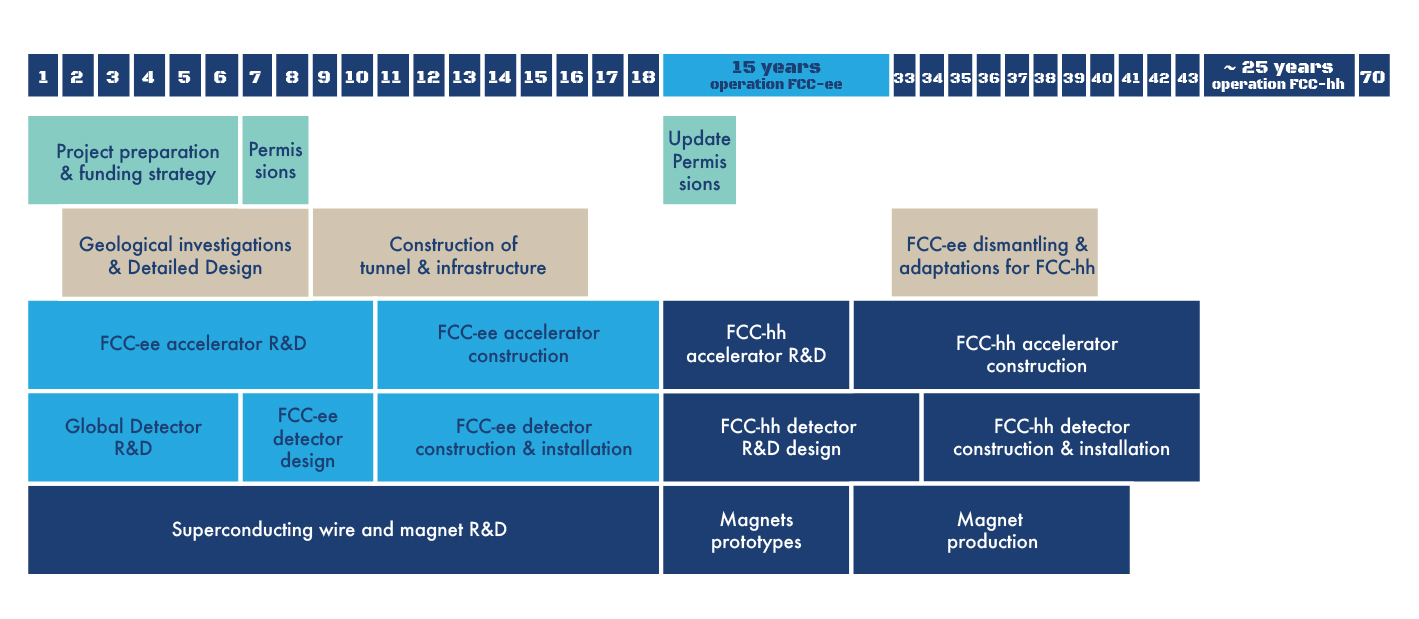
Following LEP, as with the LHC, this approach allows for the control of technical and financial risks without self-imposed constraints. This will consolidate and expand Europe’s leadership in particle and high-energy physics for decades to come.
Finally, the new research infrastructure, serving a global community, closely involving industrial partners, and providing training at all educational levels for many decades to come, will create the greatest socio-economic impact.